---
title: "How to use Reflection to Document your Data Model based on JPA Annotations"
date: 2013-06-27T21:18:41+00:00
author: "poornerd"
tags: ["annotations", "hibernate", "java", "jpa"]
canonical: https://www.poornerd.com/2013/06/27/how-to-use-reflection-to-document-your-data-model-based-on-jpa-annotations/
source: Raw Markdown twin of the HTML article; content is the original source.
---
[ ](https://www.poornerd.com/wp-content/uploads/2013/06/Screen-Shot-2013-06-27-at-23.02.041.png)So using JPA, Hibernate or EBeans is cool when you can just annotate your Java classes, but haven’t you always wished you could “generate” documentation of your data model from the code? Pulling information of the the JPA / Hibernate and other validation annotations?
Assuming you have all those nice Annotations in your beans:
](https://www.poornerd.com/wp-content/uploads/2013/06/Screen-Shot-2013-06-27-at-23.02.041.png)So using JPA, Hibernate or EBeans is cool when you can just annotate your Java classes, but haven’t you always wished you could “generate” documentation of your data model from the code? Pulling information of the the JPA / Hibernate and other validation annotations?
Assuming you have all those nice Annotations in your beans:
@Entity
@Table(name = "project_bills")
public class Bill extends Model {

	private static final long serialVersionUID = 1L;

	@Id
	@Column(name="PBI_ID")
	public Long id;

	@DoubleFormat
	@Column(name="PBI_BILL_AMOUNT",length=22)
	public Double billAmount;

	@Column(name="PBI_BILL_DATE")
	@DateTime(pattern="dd.MM.yyyy")
	public Date billDate;

	@Column(name="PBI_BILL_NUMBER",length=10)
	public String billNumber;

	@Column(name="PBI_CAN_BILL")
	public Boolean canBill;

	@Column(name="PBI_COMMENT",length=65535)
	public String comment;

	@Column(name="PBI_PAID_DATE")
	@DateTime(pattern="dd.MM.yyyy")
	public Date paidDate;
Here is an example of how to go about accomplishing that task:
public static String listEntities(String _package) {
        StringBuffer retval = new StringBuffer();
        Reflections reflections = new Reflections(_package, Play.application().classloader());
        Set<Class<?>> classes = reflections.getTypesAnnotatedWith(javax.persistence.Entity.class);
        for (Class c : classes) {
            retval.append(c.getName() + "\n");
            retval.append(listAnnotations(c.getName()) + "\n\n");
            retval.append(listAttributes(c.getName()) + "\n\n");
        }
        return retval.toString();
    }

    public static String listAnnotations(String _class) {
        StringBuffer retval = new StringBuffer();
        try {
            Annotation[] annotations = Class.forName(_class).getAnnotations();
            if (annotations.length != 0) {
                for (int j = 0; j < annotations.length; j++) {
                    retval.append(annotations[j].toString() + ": " + annotations[j].annotationType() + "\n");
                }
                retval.append("\n");
            }
        } catch (ClassNotFoundException e) {
            System.out.println(e.toString());
            return retval.toString();
        }
        return retval.toString();
    }

    public static String listAttributes(String _class) {
        StringBuffer retval2 = new StringBuffer();
        boolean perstistent = false;
        try {
            for (Field field : Class.forName(_class).getDeclaredFields()) {
                Class type = field.getType();
                String name = field.getName();
                perstistent = false;
                StringBuffer retval = new StringBuffer();
                retval.append("\t" + name + " (" + type + ")\n");
                Annotation[] annotations = field.getDeclaredAnnotations();

                if (annotations.length != 0) {
                    for (int j = 0; j < annotations.length; j++) {
                        retval.append(annotations[j].toString() + ": " + annotations[j].annotationType() + "\n");
                        if (annotations[j].toString().startsWith("@javax.persistence")) {
                            perstistent = true;
                        }
                    }
                    retval.append("\n");
                }
                if (perstistent) {
                    retval2.append(retval);
                }
            }
        } catch (ClassNotFoundException e) {
            System.out.println(e.toString());
            return retval2.toString();
        }
        return retval2.toString();
    }
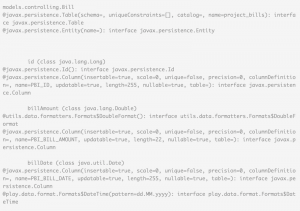
Which will generate something like this:
models.controlling.Bill
@javax.persistence.Table(schema=, uniqueConstraints=[], catalog=, name=project_bills): interface javax.persistence.Table
@javax.persistence.Entity(name=): interface javax.persistence.Entity

	id (class java.lang.Long)
@javax.persistence.Id(): interface javax.persistence.Id
@javax.persistence.Column(insertable=true, scale=0, unique=false, precision=0, columnDefinition=, name=PBI_ID, updatable=true, length=255, nullable=true, table=): interface javax.persistence.Column

	billAmount (class java.lang.Double)
@utils.data.formatters.Formats$DoubleFormat(): interface utils.data.formatters.Formats$DoubleFormat
@javax.persistence.Column(insertable=true, scale=0, unique=false, precision=0, columnDefinition=, name=PBI_BILL_AMOUNT, updatable=true, length=22, nullable=true, table=): interface javax.persistence.Column

	billDate (class java.util.Date)
@javax.persistence.Column(insertable=true, scale=0, unique=false, precision=0, columnDefinition=, name=PBI_BILL_DATE, updatable=true, length=255, nullable=true, table=): interface javax.persistence.Column
@play.data.format.Formats$DateTime(pattern=dd.MM.yyyy): interface play.data.format.Formats$DateTime

	billNumber (class java.lang.String)
@javax.persistence.Column(insertable=true, scale=0, unique=false, precision=0, columnDefinition=, name=PBI_BILL_NUMBER, updatable=true, length=10, nullable=true, table=): interface javax.persistence.Column
Of course this is only the tip of the iceberg, but you get the idea.
Let me know if you have some good ideas of what other types of documentation can be generated from the source code.